
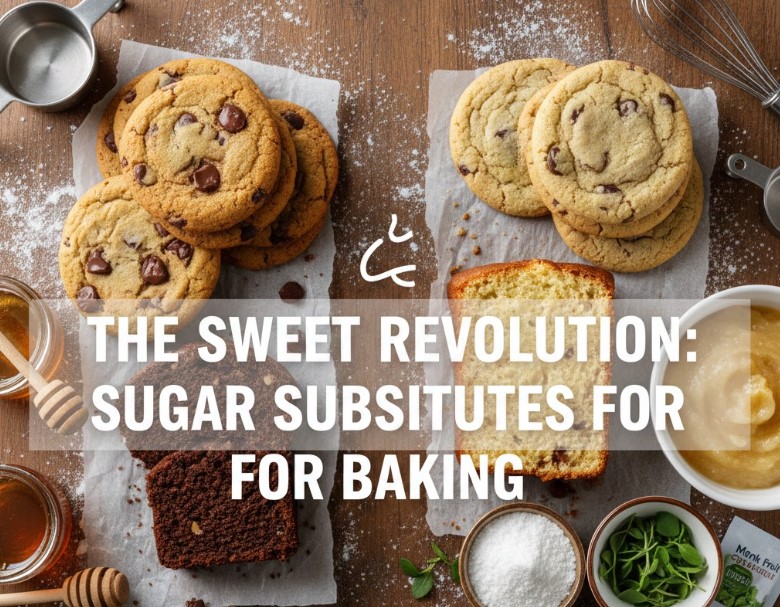
Diving into the world of sugar substitutes for baking can feel like embarking on a complex scientific mission, it’s an exciting journey that promises satisfying, guilt-reduced desserts.
The food space for alternative sweeteners has never been richer, offering everything from plant-derived zero-calorie options to natural fruit-based syrups. Mastering these alternatives is the key to unlocking a whole new dimension of healthy, flavorful baking, transforming classic recipes into mindful masterpieces.
The quest for effective sugar substitutes for baking goes far beyond mere sweetness. In baking, sugar is an indispensable workhorse, contributing significantly to moisture retention, browning (the wonderful Maillard reaction and caramelization), leavening, and providing the essential bulk and tender texture we crave in cakes, cookies, and breads.
Simply swapping equal parts of a super-concentrated sweetener like pure Stevia for granulated sugar will result in a disastrously dense, dry, and over-sweetened product.
Therefore, understanding the unique properties of each substitute and how it interacts with the other ingredients is paramount to success. This comprehensive guide is your essential toolkit for navigating the myriad options and achieving consistently delicious results without traditional sugar.
Natural Syrups and Unrefined Alternatives
The desire for wholesome, less-processed sweetness has driven many bakers toward natural syrups and unrefined granular alternatives.
While these options still contain sugars and calories, they often bring with them the added benefits of trace minerals, complex flavors, and a slightly lower glycemic index compared to highly refined white sugar.
They are prized for their ability to contribute significant moisture and richness to baked goods, making them excellent choices for chewy cookies, moist cakes, and deeply flavored quick breads.
Maple Syrup:
Maple syrup, the pure sap of the maple tree, is far more than just a topping for pancakes; it is a complex and nuanced sugar substitute for baking.
True 100% pure maple syrup, classified by its color and flavor intensity (from golden delicate taste to very dark strong taste), carries a distinct, earthy, and caramelized profile that complements ingredients like nuts, whole grains, and spices wonderfully.
Its chemical composition, primarily sucrose with small amounts of glucose and fructose, contributes to its smooth, rich sweetness. When substituting maple syrup for granulated sugar, the first crucial step is recognizing its heightened sweetness and, more importantly, its liquid form.
Typically, a baker uses 2/3 to 3/4 cup of maple syrup for every 1 cup of sugar, and they must reduce other liquids in the recipe by about 2 to 4 tablespoons to prevent the final product from becoming overly wet or dense.
This reduction is vital for maintaining the structural integrity of a cake or cookie dough. Maple syrup excels in recipes that benefit from its moistening properties and rich flavor, such as whole-wheat muffins, oatmeal cookies, and dense, warming spice cakes, ensuring the baked goods remain tender and flavorful for days.
Honey:
Honey, nature’s ancient sweetener, offers immense variability depending on the floral source from which the bees gathered the nectar, ranging from the light, delicate notes of clover honey to the bold, almost medicinal richness of buckwheat honey.
This varied flavor profile allows honey to subtly shift the character of any baked good, making it a versatile sugar substitute for baking.
Like maple syrup, honey is a liquid and is sweeter than granulated sugar due to its high fructose content, requiring a reduction in volume (typically 2/3 to 3/4 cup for every 1 cup of sugar) and a corresponding reduction in other liquids in the recipe.
The high fructose content also means honey caramelizes and browns much more quickly than sugar, sometimes leading to an over-browned exterior before the interior is fully cooked. To combat this, experienced bakers often reduce the oven temperature by 25°F (15°C) when baking with honey.
Furthermore, honey is slightly acidic, which can sometimes interfere with leavening; therefore, adding a small amount of baking soda (about 1/4 teaspoon per cup of honey) helps neutralize this acidity, ensuring proper rise and an even, delicate crumb.
Honey’s natural humectant properties also guarantee that cakes and cookies made with it retain moisture exceptionally well, often becoming softer and chewier over time.
Coconut Sugar:
Coconut sugar, derived from the sap of the coconut palm flower, has gained significant popularity as a preferred granular sugar substitute for baking because it is chemically unrefined and has a lower glycemic index (GI) compared to table sugar.
Its main advantage is its near 1:1 substitution ratio for white sugar by volume, making it incredibly user-friendly for direct swaps in traditional recipes without the need to adjust liquids. However, coconut sugar is slightly less sweet than granulated sugar, so bakers who prefer a very sweet result may need to increase the amount slightly.
Texturally, it has a coarser, more crystalline structure than refined sugar, and it imparts a warm, molasses-like or burnt caramel flavor, akin to brown sugar. This makes it an ideal stand-in for brown sugar in recipes like chocolate chip cookies or crumble toppings, where its flavor depth is a welcome addition.
While its lower GI is appealing, it’s important to note that coconut sugar does not dissolve as readily or completely as white sugar, which can sometimes lead to a slightly grainier texture in very smooth, fine-crumbed cakes or creamy frostings. Nevertheless, its simple substitution and complex flavor profile make it a natural favorite for mindful baking.
Molasses:
Molasses, a dark, viscous syrup, is a true powerhouse among sugar substitutes for baking, particularly when seeking deep, robust flavor and dark coloration. It is the byproduct left after the crystallization of sugar from cane juice or beet juice.
It is often celebrated for being a source of various minerals, including iron and calcium, making it the most mineral-rich of the common sweeteners. Different varieties exist, from the light, milder-flavored types to the strong, sometimes slightly bitter-tasting blackstrap molasses.
When used as a substitute, molasses is primarily reserved for recipes where its intense flavor is integral, such as gingerbread, Boston brown bread, and baked beans.
Similar to honey, it is acidic, and its use necessitates the addition of baking soda to aid leavening and neutralize the flavor. While it’s rarely used as a full 1:1 replacement for sugar due to its overwhelming flavor, it is frequently used to provide moisture, rich color, and a uniquely chewy texture, often in combination with other sweeteners.
For example, a small amount of molasses added to a zero-calorie sweetener can provide the much-needed browning and depth of flavor that the substitute lacks, acting as a crucial bridge between refined and unrefined baking.
Fruit Purées and Concentrates:
Using fruit purées and concentrated fruit juices represents the ultimate embrace of whole-food, unrefined sugar substitutes for baking. These options replace sugar by leveraging the natural fructose and glucose found in the fruit, along with the bulk provided by the fruit’s fiber and water content.
When substituting with a purée like applesauce, the conversion is tricky because you are replacing not just the sweetness but also part of the fat and volume.
A common strategy is to replace up to half of the required fat in a recipe with an equal amount of purée and then use a purée (like date paste, which is intensely sweet) to replace a portion of the sugar.
This results in baked goods that are exceptionally moist, often quite dense, and boast a significant fiber boost. For example, mashed banana is a popular choice, as its powerful flavor masks the absence of some sugar and its starchy nature helps bind ingredients, making it perfect for quick breads and morning muffins.
However, due to the high moisture and fiber, the texture will be quite different, compared to the crisp results achieved with granulated sugar, so adjustments to the dry ingredients may be necessary to find the perfect balance.
Zero- and Low-Calorie Alternatives: The Low-Carb Contenders
For those rigorously managing blood sugar, following a ketogenic (keto) diet, or simply aiming for maximum calorie reduction, the category of zero- and low-calorie sugar substitutes for baking is essential.
These alternatives provide sweetness with minimal or no effective carbohydrates, making them powerful tools for crafting guilt-free desserts. However, they introduce the most significant technical challenges to baking.
Granulated sugar provides essential bulk (volume), aids in the creaming process for aeration, lowers the freezing point (important for ice cream), and promotes the necessary browning and caramelization in crusts.
Since zero-calorie sweeteners lack these fundamental physical properties, successful baking with these alternatives requires strategic compensation, often achieved through blending and the use of specific bulking agents.
Stevia: The Plant-Derived Intensity
Stevia is arguably the most well-known plant-derived, zero-calorie sugar substitute for baking. It is extracted from the leaves of the Stevia rebaudiana plant, with the sweetness primarily coming from compounds called steviol glycosides.
Pure Stevia extract is incredibly potent, often cited as being 200 to 300 times sweeter than table sugar. This high intensity presents the core baking challenge: the minuscule amount required to achieve sweetness offers absolutely no bulk to the recipe.
Substituting 1 cup of sugar with just a fraction of a teaspoon of pure Stevia powder or liquid will result in a flat, dense, and structurally compromised baked good. Consequently, Stevia is most effective in baking when used as a blend.
Commercial 1:1 Stevia blends are formulated by mixing the intense extract with bulking agents like Erythritol, Maltodextrin, or Dextrose (though be mindful of the carb content of the latter two if strictly low-carb).
Flavor-wise, Stevia can carry a lingering, sometimes metallic or licorice-like aftertaste, which is more pronounced when used in high concentrations, making it a sweetener whose optimal use is often found through careful experimentation and blending with other sweeteners to achieve a balanced profile.
Monk Fruit (Luo Han Guo): The Clean, Fruity Sweetener
Monk Fruit, or Luo Han Guo, is another naturally derived, zero-calorie sugar substitute for baking, hailing from a small round fruit native to Southern China. Its intense sweetness, which comes from compounds called mogrosides, is 150 to 200 times sweeter than sugar.
Monk Fruit has rapidly grown in popularity due to its generally cleaner flavor profile compared to Stevia; it often lacks the bitter or metallic aftertaste that some individuals detect.
Like Stevia, pure Monk Fruit extract offers no bulk, necessitating its use in a concentrated liquid form for sweetening frostings or beverages, or its inclusion in 1:1 baking blends with bulking agents such as Erythritol or Allulose.
The choice of bulking agent significantly dictates the final performance of the Monk Fruit product in baking. When combined with Erythritol, the resulting blend can be easily swapped for sugar, but the baked goods may lack browning.
As a rule of thumb for sugar substitutes for baking, Monk Fruit blends are excellent for achieving a natural sweetness without compromising the structural roles that require volume, provided the recipe accounts for the lack of browning and potentially faster drying.
Erythritol: The Popular Sugar Alcohol
Erythritol is a sugar alcohol (polyol) that has become a cornerstone of low-carb and keto sugar substitutes for baking. It is about 60% to 80% as sweet as sugar, meaning you usually need to increase the volume slightly to match the desired sweetness (approximately 1 and 1/3 cups of Erythritol for every 1 cup of sugar).
Erythritol is technically low-calorie, with only about 0.2 calories per gram, and because it is minimally metabolized by the body, it has virtually no impact on blood glucose or insulin levels, making it ideal for low-carb diets.
However, it possesses two key physical properties that challenge bakers: first, it has a notable cooling sensation on the tongue, which is a physical reaction as the crystals dissolve. While this can be refreshing in certain desserts, it can be undesirable in baked goods meant to taste warm and comforting.
Second, Erythritol is prone to re-crystallization upon cooling, which can lead to a gritty or grainy texture in cookies or cakes the day after they are baked.
This issue can be mitigated by using powdered (confectioner’s) Erythritol blends, which dissolve better and lead to a smoother final texture, making them the preferred choice for frostings and finer baked goods.
Allulose: The Rare Sugar Revolution
Allulose, often marketed as a “rare sugar,” represents a significant advancement in sugar substitutes for baking due to its remarkably sugar-like behavior. While it is chemically a monosaccharide (a sugar), it is absorbed but not metabolized by the human body, resulting in near-zero effective carbohydrates and calories, and no impact on blood glucose.
Allulose is about 70% as sweet as sugar, requiring a similar 1 and 1/3 cup for 1 cup substitution ratio as Erythritol. The reason Allulose is frequently hailed as a game-changer is its ability to perform two crucial functions that its zero-calorie counterparts often fail at: it browns and caramelizes.
This property makes it invaluable for creating sugar-free caramel, toffee, and crusts that possess the desired golden-brown color and flavor depth.
Furthermore, it lacks the cooling sensation associated with Erythritol. However, Allulose is highly hygroscopic (it attracts and retains moisture), which means that baked goods made with it may be softer, more prone to sinking, and may not achieve the desired crispness in cookies.
Bakers often need to slightly reduce the liquid content in their recipes or blend Allulose with a less-hygroscopic sweetener like Erythritol to achieve a firmer final set, positioning it as an advanced but highly rewarding alternative.
Xylitol and Maltitol: Other Sugar Alcohols (Use with Caution)
While Erythritol is the most widely used and generally best-tolerated sugar alcohol for low-carb sugar substitutes for baking, Xylitol and Maltitol are also available, though they come with distinct considerations.
Xylitol is comparable in sweetness to sugar, measures 1:1, and does not have the cooling effect of Erythritol. It is highly valued for its ability to create crystalline structures for items like sugar-free hard candy.
However, it contains more calories than Erythritol (about 2.4 calories per gram) and is notorious for causing digestive distress in sensitive individuals when consumed in large quantities.
Maltitol is another sugar alcohol that performs similarly to sugar in terms of bulk and sweetness but has a measurable impact on blood sugar and is closer to sugar in calorie content, making it less ideal for strict keto diets.
Xylitol is highly toxic to dogs (even in very small amounts), necessitating extreme caution when baking with it in households with pets. For general baking, Erythritol and Allulose, often in combination, have become the more reliable and safer zero- and low-carb favorites.
Essential Tips for Baking Success in The Baker’s Handbook
Baking is a delightful intersection of culinary art and practical chemistry. Unlike cooking, where improvisation is encouraged, baking demands precision.
Mastering the fundamental techniques ensures consistent, high-quality results every time. These essential tips cover everything from ingredient preparation to the critical steps of heat and cooling management.
Ingredient Temperature is Not Optional: The Creaming Principle
Achieving the perfect texture in many classic baked goods, particularly cookies, cakes, and quick breads, hinges entirely on the temperature of your ingredients, especially butter and eggs.
Butter used in the creaming method, the process of beating butter and sugar together, must be truly “room temperature,” which typically means between 68°F and 72°F (20°C and 22°C). At this temperature, the butter is pliable enough to incorporate the sharp edges of the granulated sugar crystals without melting.
As the mixer whips the mixture, the sugar crystals cut into the butter, creating millions of tiny air pockets. These incorporated air bubbles are fundamental to leavening, trapping gases released by chemical leaveners during baking, resulting in a tender, light, and well-risen crumb structure.
If the butter is too cold, it won’t cream properly, and the final product will be dense and heavy. If the butter is too warm or oily, the air pockets will collapse, resulting in a greasy texture.
Similarly, eggs should also be at room temperature; cold eggs can chill the creamed butter, causing it to seize, curdle, and prematurely release the trapped air, undermining the entire leavening process and resulting in an uneven batter.
The Critical Importance of Accurate Measurement
In baking, measurement is the cornerstone of reproducibility, and two common errors frequently sabotage the efforts of novice bakers: incorrect flour measurement and the failure to use weight measurements for key ingredients.
The most common pitfall when measuring flour by volume is the “scoop and pack” method, which involves plunging a measuring cup directly into the flour bag and leveling it off. This action compresses the flour, often resulting in 20% to 30% more flour than intended, leading to a dry, dense, and tough final product.
The correct technique is the “spoon and level” method: gently spoon the flour into the measuring cup until overflowing, then use a straight edge (like the back of a knife) to sweep the excess off the top.
While volume measurements can suffice for many liquids, using a digital kitchen scale to weigh major ingredients like flour, sugar, butter, and liquids is the gold standard for precision.
Weight is an absolute, immutable quantity, while volume is highly variable based on particle size, density, and packing method. Adopting a scale, will immediately elevate baking results to a professional level of consistency.
Understanding and Controlling Gluten Development
Gluten is the network of proteins formed when water is added to flour and then mixed. This elastic structure provides the necessary framework and chewiness to baked goods, but it must be carefully controlled.
In yeast breads, strong gluten development (achieved through extensive kneading) is desired to trap the large amounts of carbon dioxide gas and create the classic airy, chewy structure.
However, in delicate cakes, biscuits, and muffins, excessive gluten development leads to a tough, rubbery texture. The key tip is to mix wet and dry ingredients only until just combined. Once the liquid touches the flour, the clock on gluten development starts ticking.
Continuing to mix well after the flour is incorporated begins to develop a strong, tight gluten network. This is why many recipes instruct to fold in the dry ingredients by hand or mix on the lowest speed until only a few streaks of flour remain, and then stop immediately.
A slightly lumpy muffin batter is preferable to a tough one. For tenderizing, ingredients like butter and oil coat the flour particles, inhibiting gluten formation; this is known as the shortening effect, further highlighting why careful mixing is essential for a delicate crumb.
Oven Calibration and Strategic Rack Placement
The best recipe in the world can be ruined by a poorly regulated oven, making oven calibration and heat management paramount to sugar substitutes for baking success.
The vast majority of consumer ovens are inaccurately calibrated and can easily fluctuate by 25°F to 50°F (15°C to 30°C) above or below the set temperature. Investing in an inexpensive, hangable oven thermometer is the only way to confirm the true temperature and adjust the dial accordingly.
Furthermore, heat distribution within an oven is rarely uniform; most ovens have significant hot and cold spots. For optimal, even baking, the middle rack is the default recommendation, as it is farthest from the heating elements at the top and bottom.
However, rack placement should be strategic: if a crust needs browning, the item may be briefly moved to the lower third; if a cake top is browning too quickly, it might be moved to the upper third. Regardless of placement, always ensure adequate air circulation around the baking vessel.
Pans should not touch the sides of the oven, nor should multiple pans be crowded so closely that they block the flow of heat, as this can create steam and inhibit proper, consistent baking.
The Science of Leaveners: Baking Soda vs. Baking Powder
Chemical leaveners are the workhorses that provide lift and volume to cakes, cookies, and quick breads. Understanding the difference between baking soda and baking powder is non-negotiable.
Baking soda is pure sodium bicarbonate; it is a base and requires an acid (like buttermilk, brown sugar, molasses, honey, or lemon juice) and moisture to react and produce carbon dioxide gas. If a recipe contains sufficient acid, baking soda is the preferred choice, as it reacts instantly upon mixing.
However, if there is not enough acid, any remaining unreacted baking soda will leave an unpleasant metallic or soapy aftertaste and cause yellow spotting.
Baking powder, conversely, is baking soda that has been pre-mixed with a dry acid (such as cream of tartar) and a starch (to absorb moisture and prevent clumping).
Most commercial baking powders are double-acting, meaning they react twice: once when mixed with wet ingredients at room temperature, and a second, more vigorous reaction when exposed to the heat of the oven.
Because baking powder already contains the acid it needs, it should be used in recipes that do not have acidic ingredients, ensuring reliable lift without any flavor interference.
Proper Cooling and Post-Bake Handling
The job of the baker does not end when the timer buzzes; improper handling immediately after baking can destroy the structural integrity of the final product. Baked goods are extremely fragile when they first come out of the oven because their starches and proteins are still setting.
Immediate cooling is essential for stopping the cooking process (known as carryover cooking) and preventing excessive drying or gumminess. Cakes, quick breads, and most bars should be allowed to cool in the pan on a wire rack for the initial 10 to 15 minutes.
This cooling period allows the internal structure to firm up enough to be safely handled without tearing or collapsing. If the cake is removed too soon, it will stick to the pan or tear apart. If left in the pan too long, residual heat and steam will cause the bottom to become soggy.
After the initial period, the item should be gently inverted onto a wire rack to allow air to circulate completely around the top and bottom. Cooling on a rack prevents condensation from forming on the bottom of the baked good, which can lead to a sticky, unappetizing layer.
Cookies and biscuits should be transferred immediately to a rack to halt the residual heat from the baking sheet, ensuring a crisp exterior and a tender interior.
The Future of Sweetness in Your Kitchen
Embracing sugar substitutes for baking is an act of empowerment. It gives you the freedom to enjoy your favorite home-baked goods while aligning with your personal health and dietary goals, whether that means managing blood sugar, reducing calorie intake, or simply moving away from highly refined products.
The perfect sugar substitutes for baking often depend on the specific recipe. A maple syrup glaze on a pumpkin muffin is wonderful, but pure stevia in a crisp cookie is likely to fail. Experimentation, blending, and attention to the crucial roles of volume and moisture will be your guides. The sweet future of baking is here, and it’s customized by you.