
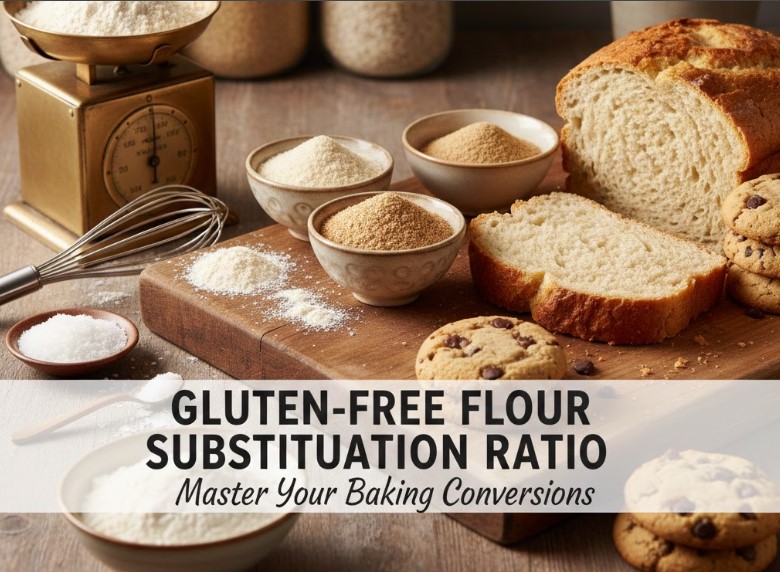
The ultimate guide to the gluten-free flour substitution ratio is here to demystify one of the most common challenges in gluten-free baking: how to successfully swap out traditional wheat flour for its gluten-free counterparts without sacrificing texture, flavor, or structure.
If you’ve ever found yourself holding a bag of rice flour, a box of starches, and a classic recipe calling for all-purpose wheat flour, you know the frustration. The simple truth is, a straight 1:1 gluten-free flour substitution ratio often leads to disappointing results.
Understanding the science behind the swap is the key to unlocking a world of delicious, successful, gluten-free baked goods. This journey into conversion isn’t just about weight; it’s about replicating the complex function of gluten using a blend of different ingredients, each playing a vital role in the final chemistry of your bake.
Successfully navigating the gluten-free flour substitution ratio requires moving beyond the single-flour mindset and embracing the power of the blend.
When bakers talk about a 1:1 substitution for all-purpose flour, they are almost always referring to a pre-mixed commercial blend, not a single gluten-free flour like almond or chickpea.
Wheat flour is not a single ingredient; it is a complex structure of proteins (gluten) and starch that provides elasticity, structure, and rise. When we create a gluten-free flour substitution ratio at home, we must meticulously combine different flours and ingredients to mimic these properties.
Ignoring this fundamental difference is the reason many initial attempts at gluten-free baking fail. By learning how to create a balanced blend, you gain control over your ingredients, allowing you to tailor the ratio to the specific demands of your recipe, whether it’s a light and airy pastry or a chewy, rustic bread.
Why 1:1 Doesn’t Work (And What to Do Instead)
The biggest stumbling block for new gluten-free bakers is the widely perpetuated myth that you can use a single gluten-free flour in a straight 1:1 gluten-free flour substitution ratio for wheat flour.
While commercial “cup-for-cup” blends have improved, relying on a single ingredient or even an unfamiliar pre-made blend without understanding its components can lead to dry, grainy, or overly dense results.
Wheat flour’s success comes from a perfect balance of protein and starch; when we remove the gluten protein, that balance is immediately thrown into chaos, requiring a complex, multi-ingredient approach to restore functionality.
Simply pouring a cup of, say, almond flour, into a recipe demanding wheat flour is fundamentally misunderstanding the chemistry of the bake and why a true gluten-free flour substitution ratio must be an engineered blend.
Flours Have Dramatically Different Protein and Starch Content
A key reason the straight gluten-free flour substitution ratio fails is the massive disparity in the nutritional and chemical makeup of individual flours compared to all-purpose wheat flour. Wheat flour is meticulously milled to a specific ratio of starch (for tender softness) and gluten-forming proteins (for elasticity).
In contrast, many single gluten-free alternatives lean heavily in one direction. For example, coconut flour and almond flour are high in protein, fiber, and fat, making them far more absorbent and heavier than wheat flour, often resulting in a crumbly, dense final product if used 1:1.
Conversely, starches like potato starch or tapioca starch are almost pure carbohydrate, providing tenderness but zero structure or binding power, leading to baked goods that collapse or are gummy when cooled.
Therefore, achieving a successful gluten-free flour substitution ratio requires intentionally combining a high-protein, dense flour with a light, pure starch to mimic the functional balance found naturally in wheat.
Unpredictable and Extreme Differences in Water Absorption
The most immediate practical failure of a simple 1:1 gluten-free flour substitution ratio is the drastic difference in hydration needs. Gluten-free flours absorb water in highly variable and often extreme ways compared to wheat flour.
Wheat flour absorbs water somewhat slowly and predictably, forming the elastic gluten network. Ingredients like coconut flour, due to their high fiber content, can absorb up to four times more liquid than wheat flour by volume, meaning a recipe that was perfectly moist with wheat flour becomes utterly dry, brick-like, and impossible to mix when coconut flour is substituted cup-for-cup.
On the other hand, certain starches or refined grain flours (like white rice flour) might absorb less or differently, leading to a batter that is too runny and fails to set.
This makes adjusting the liquid content of the recipe, not just the flour type, an essential part of mastering the gluten-free flour substitution ratio, demanding a keen eye for batter consistency rather than blind reliance on initial measurements.
Lack of Cohesion Requires Specialized Binders
The fundamental function that a simple 1:1 gluten-free flour substitution ratio ignores is the elastic, cohesive nature of gluten. Gluten provides the “stickiness” that holds a cookie together as it spreads, and the “chew” that prevents a loaf of bread from crumbling when sliced.
Since individual gluten-free flours lack this protein network, the final product, if baked without additional binders, will almost certainly be dry, brittle, and fall apart easily. This is why hydrocolloids, such as xanthan gum, guar gum, or psyllium husk powder, are non-negotiable additions to any homemade gluten-free flour substitution ratio.
These specialized ingredients are added in tiny amounts, but they mimic the stickiness and elasticity of gluten by binding large amounts of moisture, ensuring the flour particles adhere to one another and the baked item maintains its structural integrity from oven to plate.
Texture, Flavor, and Grind Size Impart Unwanted Qualities
Beyond basic chemistry, attempting a 1:1 gluten-free flour substitution ratio introduces flavor and textural issues that can ruin a familiar recipe. Most traditional baking recipes rely on the neutral, mild flavor of wheat flour.
Substituting with a highly flavored ingredient like chickpea flour, which can impart a savory or slightly bitter note, will fundamentally change the character of a delicate dessert like a vanilla cake. Furthermore, the grind size matters significantly.
Brown rice flour, a common base for gluten-free blends, is often much coarser than finely milled wheat flour, leading to a gritty, unpleasantly sandy texture in the finished product.
A proper gluten-free flour substitution ratio must take this into account, often pairing coarser flours with ultra-fine starches like tapioca or cornstarch, which dissolve beautifully, to ensure a smooth, velvety mouthfeel comparable to the original wheat-based recipe.
Different Reactions to Leavening and Heat
Finally, single gluten-free flours react differently to heat and leavening agents (like yeast, baking soda, and baking powder). Wheat flour, due to the gluten network, has the ability to stretch and hold the gasses produced by leavening, resulting in a light, high-rising structure.
Without gluten, that gas escapes quickly, causing the baked item to flatten or become dense, a common disappointment when using a poor gluten-free flour substitution ratio.
A custom-engineered blend, combined with the power of hydrocolloids, creates a temporary, stable structure that can trap gasses just long enough for the heat of the oven to set the final product.
This is why yeast bread, in particular, demands a specialized, highly functional blend heavy on structure flours (like sorghum or millet) and often requires psyllium husk to provide the extra elasticity needed to withstand a lengthy rising period. The entire system must be re-engineered, making a simple 1:1 swap impossible for achieving high-quality results.
Engineering Your Perfect Gluten-Free Flour Substitution Ratio for Specific Bakes
Now that we understand why a simple 1:1 swap fails, the next crucial step in mastering the gluten-free flour substitution ratio is learning to tailor the blend to the specific requirements of the final product. A delicate vanilla cake requires a different ratio than a sturdy, chewy artisan bread.
Success lies in balancing structure, tenderness, and elasticity, a process that moves beyond simple substitution and into deliberate formulation.
By adjusting the proportions of structural flours, starches, and binders, you can customize your gluten-free flour substitution ratio to achieve a textural match for almost any conventional recipe.
The High-Starch Ratio for Tender Cakes and Muffins
For recipes where a light, tender, and moist crumb is paramount, the optimal gluten-free flour substitution ratio heavily favors starchy components. The goal here is to minimize the heavy density often associated with whole-grain gluten-free flours while maximizing the smooth mouthfeel provided by starches.
A recommended starting ratio for this tender category is approximately 60% Structure Flours to 40% Starchy Flours. The higher proportion of starch (like tapioca, cornstarch, or potato starch) ensures the batter sets into a soft, velvety texture, preventing the dry, coarse outcome that high-protein flours can cause in a cake.
Furthermore, the selection of the structure flour should be neutral and light; fine white rice flour or sorghum flour is preferable to heavier alternatives like buckwheat or chickpea, ensuring that the finished product remains delicate and neutral in flavor, perfectly complementing light frosting or fillings.
The Balanced Ratio for Cookies and Brownies
The ideal gluten-free flour substitution ratio for drop cookies, cut-out cookies, and fudgy brownies requires a careful balance to achieve the desired chewiness without becoming crumbly or overly cake-like. This middle-ground blend typically hovers around a 70% Structure Flours to 30% Starchy Flours ratio.
The slightly higher percentage of structure flour (often brown rice or millet) provides the necessary bulk and bite, allowing the cookie to hold its shape and preventing excessive spread during baking.
These recipes also demand precise binder incorporation; typically, a higher amount of xanthan gum or a medium dose of psyllium husk is needed to keep the fat and sugar particles cohesive, ensuring the finished cookie has a desirable chew rather than shattering upon touch.
Achieving the perfect crisp edges and soft centers is a direct reflection of correctly implementing this balanced gluten-free flour substitution ratio and its required binding agent.
The High-Protein and Binder Ratio for Yeast Breads
Baking yeast-leavened bread presents the greatest challenge, as the gluten-free flour substitution ratio must replicate the robust, stretchy elasticity that allows a dough to trap yeast-produced gases for a prolonged period of rising and baking.
For artisan loaves, buns, or pizza dough, the ratio leans toward a higher concentration of structure flours; specifically those rich in fiber and protein, often around 75% Structure Flours to 25% Starchy Flours.
However, the real secret here lies in the binder. Instead of using just xanthan gum, bread recipes often require the addition of psyllium husk powder, which, when hydrated, creates a much more robust, gel-like matrix that closely mimics the function of gluten’s elastic strands.
The required amount of psyllium husk is often significantly higher (up to a tablespoon or more per 2 cups of flour blend) than the small amounts of gum used in cakes, demonstrating that for bread, the binder is not an additive but an essential structural component of the entire gluten-free flour substitution ratio.
Considering the Sensory Impact of Different Structural Flours
When formulating your personalized gluten-free flour substitution ratio, the choice of the 70% “Structure Flour” component dramatically impacts the final flavor, color, and texture of the finished product.
Different structural flours bring unique sensory properties that must be accounted for. For instance, Brown Rice Flour is a popular, cost-effective choice, but its often coarse grind can lead to grittiness, demanding that it be paired with finer starches.
Sorghum Flour offers a sweeter, neutral taste and a smoother texture, making it excellent for general-purpose blends.
Conversely, Buckwheat Flour (despite the name, it’s gluten-free) imparts a deep, earthy, and sometimes slightly bitter flavor that is fantastic for rustic breads and pancakes but unsuitable for light pastries.
Understanding these individual flavor profiles is crucial, as the best gluten-free flour substitution ratio not only performs correctly chemically but also delivers the intended flavor experience.
The Importance of Weight Over Volume in Conversion
A final, critically overlooked point when discussing the gluten-free flour substitution ratio is the inherent inaccuracy of using volume (cup) measurements. Gluten-free flours have highly variable densities.
For example, a cup of finely ground almond flour can weigh significantly less than a cup of dense, packed brown rice flour. When substituting, measuring by volume can dramatically throw off the delicate balance of your engineered ratio, resulting in too much or too little of a key component.
To achieve reproducible and consistently excellent results, bakers must transition to using a digital kitchen scale and rely on weight measurements (grams or ounces) for both the flour blend and the final substitution.
While a general rule of thumb is to substitute 1 cup of wheat flour with approximately 120 to 140 grams of your chosen gluten-free blend, consulting reliable baking charts for specific weight equivalents is the only way to truly guarantee precision in your gluten-free flour substitution ratio.
The Role of Gluten (and How to Replicate It)
The concept of the gluten-free flour substitution ratio is fundamentally a quest to mimic the unique, multi-functional properties of the gluten protein network.
Gluten is not just a filler; it is the structural backbone of nearly all conventional baked goods, and its absence is the single biggest hurdle in successful gluten-free baking. Understanding exactly what gluten does is the key to making any substitution ratio work effectively.
Gluten’s Function as the Elastic Protein Network
In traditional wheat-based baking, gluten proteins, specifically gliadin (responsible for extensibility or stretch) and glutenin (responsible for elasticity or snap back), are dormant until they are hydrated with water and agitated (kneaded or mixed).
Once activated, these proteins link together to form a highly viscous and incredibly elastic mesh. This network acts like a balloon within the dough. It traps the gases produced by leavening agents (such as yeast or baking powder), allowing the dough to rise (a process called fermentation or proofing) without the trapped gases escaping.
As the item bakes, the heat causes the trapped gases to expand further, and the protein network stretches with them until the heat finally denatures (sets) the proteins, resulting in the final, light, and airy structure of a loaf of bread or a tender cake.
This elasticity is what gives baked goods their characteristic chewiness and open crumb structure. Without this specific protein-starch interaction, any simple gluten-free flour substitution ratio will inevitably result in a dense, flat, or crumbly product.
Replicating Gluten’s Cohesiveness with Hydrocolloids
Since no single gluten-free flour possesses the protein content or chemistry to replicate gluten, a special class of ingredients known as hydrocolloids must be integrated into the gluten-free flour substitution ratio to provide the necessary cohesion and elasticity.
Hydrocolloids are substances that form a viscous, gel-like solution when mixed with water. The most common of these are xanthan gum and guar gum. When added to a gluten-free blend, these gums absorb moisture and create a pseudo-elastic matrix that effectively binds the separate flour particles together.
This binding action prevents the baked goods from simply crumbling apart once sliced or bitten into. Unlike gluten, which needs time and kneading to develop, hydrocolloids activate quickly upon hydration, which is why minimal mixing is often recommended in gluten-free baking to avoid gummy textures.
Utilizing Psyllium Husk for Structure and Volume (Especially in Bread)
For demanding applications like yeast bread, replicating the strong, lasting structure of gluten requires an even more robust solution in the gluten-free flour substitution ratio. This is where psyllium husk powder steps in.
Psyllium husk, derived from the seeds of the Plantago ovata plant, is an almost pure form of soluble fiber that, when mixed with water, creates an extremely thick, sticky, and highly plastic gel.
This psyllium gel mimics the extensibility of gluten better than xanthan or guar gum, giving gluten-free bread dough the stretchable structure it needs to be kneaded and proofed successfully without tearing.
Adding psyllium husk powder directly into the dry blend (a common starting point is 1 teaspoon per cup of blend for cakes, and 1 tablespoon per cup for bread) provides the necessary structural support to trap yeast gases and achieve the impressive volume traditionally associated with wheat loaves, fundamentally changing the performance of the overall gluten-free flour substitution ratio.
The Critical Interaction of Moisture and Hydration Time
The final piece of replicating gluten’s role revolves around the concept of hydration. Gluten-free flours, especially those high in fiber and starches, are often very absorbent and require more liquid than their wheat counterparts.
More importantly, the hydrocolloids and starches in the new gluten-free flour substitution ratio need time to fully absorb this moisture and activate. If the batter or dough is baked immediately, the water hasn’t fully migrated, resulting in a grainy texture and a crumbly structure.
Therefore, a mandatory step in successful gluten-free replication is allowing the mixture to rest for 15 to 30 minutes after mixing.
This brief rest period allows the starches to swell and the binding gums (xanthan, psyllium) to form their stable, gel-like network, transforming a loose, questionable dough into a cohesive, manageable, and bake-ready mixture; the true fulfillment of the engineered gluten-free flour substitution ratio.
Understanding the Ideal Blend Ratio: The Science Behind the Gluten-Free Flour Substitution Ratio
Moving beyond simple substitution and into the realm of custom-blending is the mark of a true gluten-free baking expert.
The concept of the “ideal blend ratio” acknowledges that all-purpose wheat flour is a carefully calibrated mix of components, and a successful gluten-free flour substitution ratio must replicate that balance by combining specialized flours.
This scientific approach ensures your baked goods achieve the desired structure, tenderness, and mouthfeel that conventional recipes rely upon.
The 60-70% Base: Structure Flours for Body and Flavor
The largest component of your ideal gluten-free flour substitution ratio must be dedicated to structure flours. These flours provide the necessary bulk, nutritional content, and flavor base for your recipe.
This category includes common staples like brown rice flour, white rice flour, millet flour, sorghum flour, and sometimes oat or almond flour. They are higher in fiber and/or protein compared to pure starches, giving the baked item its essential body and preventing it from dissolving into a pile of starch dust.
The choice within this category is critical as it dictates the final taste (e.g., the nutty profile of millet versus the neutral taste of white rice) and the resulting color of the finished product.
Achieving a successful gluten-free flour substitution ratio starts with selecting one or two complementary structural flours that align with the flavor profile of the recipe you are adapting.
The 20-30% Component: Starchy Flours for Tenderness and Lightness
To counteract the potential density and coarseness of structure flours, the ideal blend ratio requires a significant contribution from starchy flours, making up roughly 20% to 30% of the total mix.
These pure starches are key to tenderizing the final product, absorbing moisture efficiently, and contributing to the smooth, almost powdery finish that mimics finely milled wheat flour.
Key starches in this segment include tapioca starch/flour, potato starch (not potato flour), cornstarch, or arrowroot powder. The addition of these light components is what prevents the “brick-like” texture often experienced when relying solely on denser structural flours.
For exceptionally delicate items like fine cakes, you might push this segment closer to 35% or 40% to maximize tenderness, recognizing that a precise gluten-free flour substitution ratio can be tuned for specific texture goals.
The Essential Binder: Hydrocolloids Added Per-Cup
The binding agent, the hydrocolloid (xanthan gum, guar gum, or psyllium husk), is not typically calculated as part of the overall 100% flour blend weight. Instead, it is added separately to the dry ingredients, measured in small amounts relative to the total flour volume, usually on a per-cup basis.
A general guideline for a standard blend is:
- For light baked goods (muffins, cookies, cakes): 1/4 teaspoon to 1/2 teaspoon of xanthan gum per cup of the 70/30 flour blend.
- For yeasted, structured goods (bread, pizza dough): 1 teaspoon of xanthan gum, or often 1 tablespoon of psyllium husk powder per cup of the 70/30 flour blend.
This calculated addition is vital because it completes the functional chemistry of the gluten-free flour substitution ratio. Without the binder, even a perfectly balanced 70/30 flour mix will fail to hold together.
The hydrocolloid activates the necessary stickiness, bridging the gap between the separate flour particles to create a cohesive structure.
The Golden Rule of Precision: Blending by Weight
To ensure the ideal blend ratio is executed with professional accuracy, the most important technical shift is converting all measurements from volume to weight.
Because the various gluten-free flours have dramatically different densities (e.g., a cup of tapioca starch is much lighter than a cup of brown rice flour), measuring by volume will introduce inconsistency and inaccuracy into your 70/30 or 60/40 ratio.
By using a kitchen scale, you guarantee that your 65% brown rice flour and 35% potato starch blend is always consistent.
While a single cup of wheat flour generally weighs between 120 to 130 grams, your custom gluten-free flour substitution ratio should be precisely mixed in large batches by weight (e.g., 650 grams of structure flour and 350 grams of starch for a 1,000 gram batch), stored, and then measured out by weight for each recipe.
This practice eliminates variability and is the definitive final step in mastering the gluten-free flour substitution ratio.
The Critical Role of Hydration and Rest Time
One factor often overlooked when discussing the gluten-free flour substitution ratio is the need for more liquid and more rest time. Gluten-free flours, particularly the nut-based and whole-grain varieties (like almond and brown rice), are significantly more absorbent than refined wheat flour.
When using your new custom blend, you will often find that you need to increase the liquid (milk, water, or eggs) in the recipe by anywhere from 10% to 25%. The batter or dough should look and feel slightly wetter than its traditional counterpart.
Furthermore, gluten-free doughs need time for the starches and hydrocolloids to properly hydrate. If you bake immediately, the resulting product will be dry, grainy, and fall apart. Allowing the dough or batter to rest for 20 to 30 minutes (sometimes even longer for bread doughs) before baking is a non-negotiable step.
This rest period gives the binders (like xanthan gum) time to fully activate and form the stable, sticky structure needed for a cohesive bake. This technique drastically improves the final texture, transforming a crumbly mess into a uniform, moist treat, a testament to mastering the gluten-free flour substitution ratio beyond just measuring cups.